
How Can I Identify a Real Rudraksha?
With the global popularity of Rudraksha on the rise, the market has unfortunately become flooded with counterfeit beads. Fake Rudraksha — made from wood, plastic, clay, or chemically treated seeds — are sold at every price point, from inexpensive tourist fakes to expensively presented fraudulent high-mukhi beads. Learning how to identify a genuine Rudraksha is not just a matter of protecting your financial investment; it is essential to ensure that the bead you are wearing actually carries the spiritual and energetic properties you are seeking.
1. Visual Inspection: What to Look For
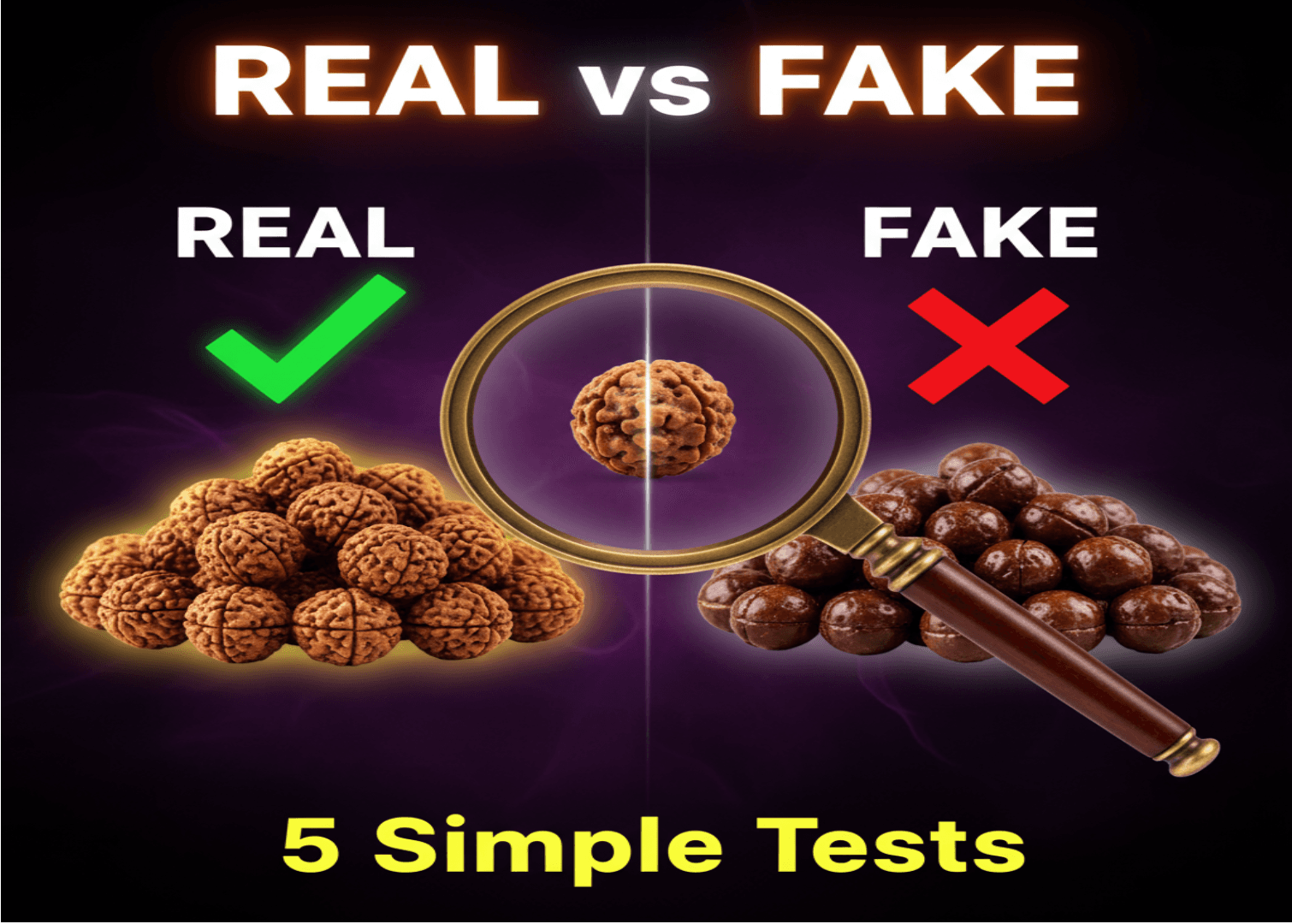
Start with a careful visual examination. A genuine Rudraksha has naturally defined mukhis — grooves or lines that run from the top (the stem attachment point) to the bottom of the bead, like the natural segments of a citrus fruit. These lines should look organic and naturally irregular — not perfectly symmetrical, not artificially cut or carved, and not unnaturally smooth. The bead's surface should have a naturally rough, textured quality. The top and bottom should show a natural hole (if already drilled) that aligns with the mukhis. Fake beads often have mukhis that are too perfectly uniform, too shallow, or clearly carved rather than naturally grown.
2. The Water Test
Place the Rudraksha in a glass of water. A genuine, fully matured and dense Rudraksha will typically sink to the bottom, while many hollow or fake beads will float. However, this test has limitations — some genuine beads, particularly those that are very dry, may initially float. And a well-crafted fake (especially a heavy wooden one) may sink. Use this as one data point among several, not as the sole determinant.
3. The Copper Coin Test
Hold the Rudraksha between two copper coins and watch for subtle movement. A genuine Rudraksha is said to produce a very slow, slight rotation due to its bioelectric properties interacting with the copper. This test is considered more anecdotal than scientific and should be viewed as supporting evidence rather than definitive proof.
4. The Boiling Test
A more definitive physical test involves boiling the Rudraksha in water for a few minutes and then examining it. A genuine bead will not dissolve, discolor significantly, or reveal artificial coating. A fake made of clay, wax-coated wood, or other materials will often reveal its true nature through this process — cracking, peeling, or discoloring. However, this test should only be used when you are willing to risk damaging the bead if it turns out to be genuine.
5. The Internal Compartment Test (Definitive)
The most scientifically definitive test is to examine the bead's internal structure. A genuine Rudraksha has as many internal seed compartments as it has external mukhis. This can be verified by cutting the bead in cross-section (destroying it) or, for valuable beads, by X-ray imaging. Many reputable Rudraksha sellers now provide X-ray certification for high-mukhi or high-value beads, which allows verification without damage. If a seller of an expensive bead refuses or is unable to provide X-ray documentation, consider this a major red flag.
6. Source and Certification
Perhaps the most reliable method for ensuring authenticity — especially for expensive or rare beads — is to purchase only from established, reputable sellers who provide written authentication documentation. Reputable Rudraksha dealers in Nepal and India often work with independent gemological laboratories to certify their beads. Look for certification from recognized bodies, not just a seller's own in-house "authenticity guarantee."
7. Price as a Clue
While price alone is not a reliable indicator of authenticity (fake beads can be sold at any price), a genuine high-mukhi Rudraksha being offered at suspiciously low prices is almost certainly inauthentic. Know the approximate market price range for the specific mukhi and source you are purchasing, and be deeply skeptical of any deal that seems too good to be true.
Conclusion
Identifying a real Rudraksha requires a combination of visual knowledge, physical testing, and source verification. Educate yourself, buy from trusted sources, demand documentation for expensive beads, and trust your instincts. An authentic Rudraksha is one of the most valuable spiritual objects you can own — take the time to ensure yours is genuine.
Om Namah Shivaya.