
The Collector's Sacred Compendium · Himalayan Relics
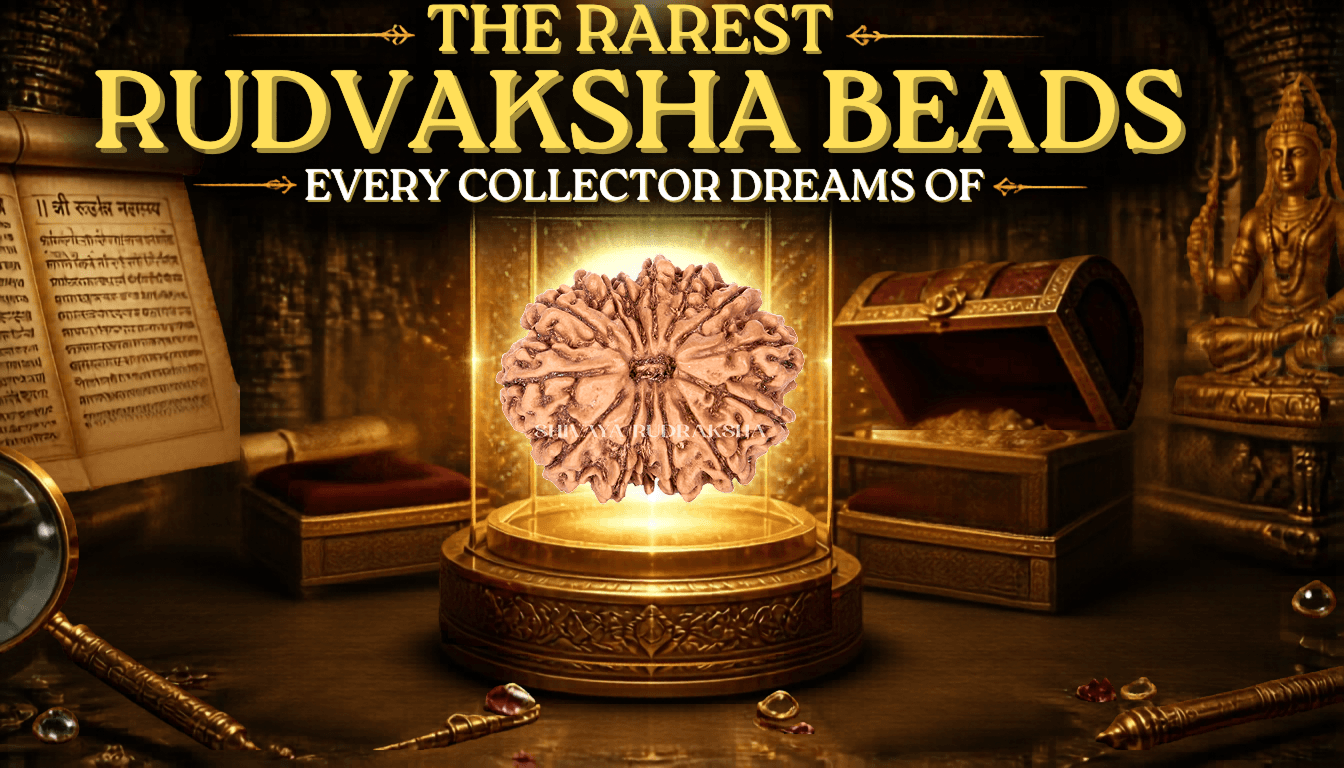
The Rarest Rudraksha Every Collector Dreams Of
Some beads appear once in a million trees. Others have not been seen for decades. These are the sacred relics that haunt every true collector's dreams.
There are Rudraksha beads—and then there are legends. While millions of people wear 5 Mukhi Rudraksha daily, a tiny fraction of the world's spiritual community devotes entire lifetimes to hunting beads so rare that most people never lay eyes on one in person. These are the Rudraksha that appear in ancient scriptures as gifts of the gods, appear in museum collections under glass, and change hands privately for sums that rival fine diamonds.
This is their story.
Rarity Profile: Fewer than 100 verified round 1 Mukhi beads are known to exist worldwide.
"To hold a genuine 1 Mukhi round Rudraksha is to hold something that most monks, scholars, and even temple priests will never touch in their lifetime. These are not just beads — they are the rarest natural objects in the entire world of sacred artefacts."
The Rarest of the Rare: The Holy Grail List
Each of these beads is a world unto itself—a condensed cosmos of divine rarity.
1. 1 Mukhi Round Rudraksha (Ek Mukhi · The Supreme Relic)
If the Rudraksha world has a holy grail, it is this. A perfectly round, naturally formed Ek Mukhi Rudraksha—with a single unbroken Mukhi line running from pole to pole—is so rare that most experts believe fewer than a hundred genuine specimens exist worldwide. The Shiva Purana states that merely gazing upon it destroys accumulated karma of a thousand lifetimes.
Unlike the more common half-moon or cashew-shaped 1 Mukhi, the round form is a true geological miracle. Its rarity is such that it is never sold in open markets; transactions happen exclusively through trusted networks of collectors and spiritual institutions, often accompanied by sworn witnesses and full documentation.
- Deity: Shiva Himself
- Planet: Sun
- Rarity: Beyond Measure
- Estimated Value: ₹10L – ₹50L+
2. Trijuti Rudraksha (The Triple Union · Trinity in Seed)
The Trijuti is three Rudraksha naturally fused together on a single stem—not glued or joined by human hand, but grown that way natively from the tree. It represents the Trimurti: Brahma, Vishnu, and Shiva in divine union. Vedic texts regard it as one of the most auspicious objects in existence.
A genuine Trijuti is almost never found. Even dedicated collectors who have spent decades searching the Himalayan markets may never encounter one. When a Trijuti surfaces, it is typically acquired immediately by temples, royal families, or serious private collectors, rarely entering the open market again.
- Deity: The Trimurti
- Planet: All Planets
- Rarity: Extraordinary
- Estimated Value: ₹5L – ₹30L+
3. Gauri Shankar Rudraksha (The Divine Couple · Shiva & Parvati)
Two Rudraksha naturally joined by a shared seed cord—not a coincidence of proximity, but a genuine organic fusion from inside the fruit itself. The Gauri Shankar represents the eternal union of Shiva (Shankar) and Parvati (Gauri), making it the supreme Rudraksha for marital harmony, love, and family prosperity.
The rarity increases dramatically when both fused beads are of equal size, perfect shape, and matching Mukhi counts. A matched-pair Gauri Shankar of 5+5 Mukhi in a large Nepali size is considered among the most auspicious objects a household can possess.
- Deity: Shiva–Parvati
- Planet: Moon
- Rarity: Very High
- Estimated Value: ₹80K – ₹5L
4. 21 Mukhi Rudraksha (Kuber's Blessing · Lord of All Wealth)
The 21 Mukhi is the highest naturally occurring Mukhi count recognized in Vedic tradition. Blessed by Kuber—the god of wealth and treasurer of the gods—this bead is said to bring limitless material abundance, multiply existing wealth, and attract fortune on a massive scale.
Finding a genuine, large, well-formed 21 Mukhi from Nepal with all faces clearly defined and unbroken is nearly impossible. Most are small, irregular, or have one damaged face; a perfect specimen commands a major collector's premium. These beads are known to have been owned by royal families across South and Southeast Asia.
- Deity: Kuber
- Planet: All Planets
- Rarity: Extraordinary
- Estimated Value: ₹5L – ₹25L+
5. 14 Mukhi Rudraksha (Deva Mani · The Third Eye of Shiva)
Called the "Deva Mani" (Jewel of the Gods), the 14 Mukhi is said to have emerged from the Third Eye of Lord Shiva. It is among the most coveted beads in serious Rudraksha collections—not just for its rarity, but for its extraordinary spiritual effects: the awakening of intuition, the opening of the Ajna chakra, and protection from negative forces.
Collectors prize large-sized (20mm+) 14 Mukhi Nepali specimens with deep, well-defined faces. It is believed that wearing a genuine 14 Mukhi significantly accelerates spiritual progress and grants the wearer the ability to perceive reality beyond the ordinary senses.
- Deity: Shiva (Third Eye)
- Planet: Saturn
- Rarity: Very High
- Estimated Value: ₹25K – ₹1.5L
6. Sawar Rudraksha (The Horse Face · Natural Phenomenon)
The Sawar Rudraksha is an extremely rare, naturally occurring bead that bears a distinct physical resemblance to a horse's face—complete with eyes, nostrils, and the elongated structure of a horse's head, all formed entirely by nature. This is not a product of carving or human modification; it is an organic accident of growth so rare that most serious collectors consider it mythological until they encounter one.
Associated with speed, victory, and the cosmic energy of Hayagriva (the horse-headed avatar of Vishnu), the Sawar Rudraksha is considered supremely auspicious for those in competitive fields, legal matters, and anyone seeking swift resolution to long-standing obstacles.
- Deity: Hayagriva
- Planet: Sun / Mars
- Rarity: Extraordinary
- Estimated Value: ₹3L – ₹20L+
7. Garbh Gauri Rudraksha (The Mother & Child · Divine Nurturance)
The Garbh Gauri is a Gauri Shankar variation in which one of the two conjoined beads is noticeably smaller—representing a mother bead cradling a child bead. This extraordinarily rare formation is the most sacred Rudraksha for fertility, safe pregnancy, child protection, and maternal blessings.
Couples who have struggled to conceive, families praying for the safe birth of a child, and mothers seeking protection for their newborns seek the Garbh Gauri with absolute devotion. Many collectors who possess one refuse to sell it under any circumstances, treating it as a family heirloom passed down through generations.
- Deity: Parvati
- Planet: Moon
- Rarity: Very High
- Estimated Value: ₹2L – ₹15L
8. 19 & 20 Mukhi Rudraksha (Narayana & Brahma · Creation Itself)
The 19 Mukhi is blessed by Lord Narayana and is considered the bead that grants material pleasures while simultaneously progressing the soul toward liberation—a rare combination. The 20 Mukhi, blessed by Brahma the creator, is among the least-documented Rudraksha in existence, with scholarly texts describing it but almost no verified modern specimens available.
Together, the 19 and 20 Mukhi represent the penultimate tier of the rare Rudraksha hierarchy. Collectors who have successfully documented and certified one of these beads consider it the crowning achievement of a lifetime of searching.
- Deity: Narayana / Brahma
- Planet: All Planets
- Rarity: Extraordinary
- Estimated Value: ₹3L – ₹20L+
The Art of Collecting Rare Rudraksha
"A serious Rudraksha collector is part archaeologist, part astrologer, part mystic, and part gemologist. The hunt is as spiritual as the ownership."
Collecting rare Rudraksha is a calling. The world's most serious collectors spend decades building networks in the Himalayan foothills, cultivating relationships with hereditary Rudraksha families in Nepal, and learning the intimate physical language of authentic beads.
What drives this obsession? For most, it begins with a spiritual experience. A collector holds a high-Mukhi bead during meditation and feels something—a current, a stillness, an inexplicable sense of contact with something beyond the ordinary. Once experienced, the search for deeper, rarer expressions of it becomes life-defining.
What Makes a Collector's Piece
Not every rare bead qualifies as a true collector's piece. Connoisseurs apply a strict set of criteria that separates a merely uncommon bead from a genuine relic:
- Completeness: Every Mukhi line must run unbroken from the top hole to the bottom hole. A single broken or merged face disqualifies a bead from top-tier status, regardless of its Mukhi count.
- Naturalness: The bead must show zero signs of human modification—no carved lines, no deepened grooves, and no chemical treatments. Authenticated X-ray imaging showing natural internal seed structure is standard practice.
- Symmetry: The Mukhi lines should be evenly distributed around the bead's circumference. Extreme clustering or crowding of faces on one side is a natural imperfection that reduces collector value.
- Size: Within each Mukhi category, larger specimens are always rarer. A 25mm 14 Mukhi is dramatically more valuable than an 18mm example of the same bead.
- Provenance: The most valuable collector's pieces come with documented origins—ideally traceable to a specific region or harvesting family in Nepal, with photographic records from before processing.
- Certification: Lab certificates from recognised institutions, X-ray documentation, and video recordings of the bead's physical testing are essential for any bead priced above ₹1 lakh.
Where Do These Rare Beads Come From?
All of the rarest Rudraksha originate from the wild Elaeocarpus ganitrus forests of Nepal—specifically from the Himalayan foothills across the Terai belt. These forests are not cultivated; the trees grow wild, and their fruit is harvested once a year by hereditary families who have performed this work for generations.
Most rare beads are discovered through the careful, patient sorting of large harvests. A harvester might collect thousands of berries from a forest region and find a single exceptional bead among them. Sometimes an entire generation passes without a particular rarity appearing. This is why serious collectors maintain long-term relationships with harvesting families—they act as patrons of a living tradition.
Investment Perspective: Verified rare Rudraksha—particularly 1 Mukhi round, Trijuti, and large 21 Mukhi specimens—have historically appreciated at a rate that outpaces most conventional investments. Unlike financial instruments, they carry no counterparty risk, are unaffected by market cycles, and hold deep religious significance that ensures continued demand across generations.
How to Begin Your Own Collection
Every legendary collection began with a single bead. You do not need access to a 1 Mukhi round to begin a meaningful Rudraksha collection. The wisest collectors advise starting with authenticated, high-quality Nepali Rudraksha in the 5–14 Mukhi range—beads that are rare enough to be significant, well within reach of a thoughtful budget, and perfect for developing the eye needed to recognize truly exceptional specimens.
Study the physical characteristics of authentic Nepali Rudraksha obsessively. Learn to read the Mukhi lines, assess surface texture, understand size gradations, and identify signs of tampering. Build relationships with reputable, certified sellers before expanding your network. Above all, cultivate patience—the rarest beads do not reveal themselves to hurried seekers.
Conclusion: Worth a Lifetime of Searching
The rarest Rudraksha are not merely objects of collection. They are living witnesses to the wild improbability of the sacred—proof that nature occasionally, in moments of impossible grace, produces something that no human hand could design.
To seek them is to participate in one of the oldest forms of spiritual devotion on Earth. To find one is to hold, briefly, a small piece of the infinite.
ॐ NAMAH SHIVAYA ॐ