
Sacred Economics · Vedic Wisdom · Buyer's Guide
Why Are Some Rudraksha
So Costly?
The real truth behind the price tags — from divine rarity to planetary rarity and the forces that make one bead worth more than gold.
"A genuine 1 Mukhi Nepali Rudraksha can cost more than a luxury car. A 5 Mukhi from Java can be bought for the price of a cup of tea. Both are Rudraksha — so what accounts for a price gap of over 5,000 times?"
If you have ever searched for Rudraksha beads online or visited a spiritual shop, you have likely been puzzled — even shocked — by the enormous variation in prices. A simple 5 Mukhi bead might cost ₹50, while a 1 Mukhi round Rudraksha can command ₹50 lakh or more. Is this just clever marketing, or are there genuine reasons behind these astronomical price differences?
The answer is both complex and deeply rooted in ecology, astrology, supply chains, and centuries of spiritual tradition. In this guide, we break down every factor that determines the cost of a Rudraksha bead — and help you understand exactly what you are paying for.
◆ The Core Factors That Drive Rudraksha Prices
Geographic Origin
Nepali Rudraksha are far rarer and more potent than Java varieties — and priced accordingly, often 10–50× higher.
Number of Mukhis
Higher Mukhi counts (10–21) are exponentially rarer in nature. A 21 Mukhi may appear only once in millions of trees.
Size of the Bead
Larger Rudraksha (18mm+) are significantly rarer than smaller ones and considered more energetically powerful.
Natural Shape
A perfectly round, symmetrical bead with evenly spaced Mukhis is rare. Shape imperfections reduce value drastically.
Authenticity & Testing
Certified, lab-tested, and X-ray verified Rudraksha from reputable sources command a significant authenticity premium.
Metal Capping
Gold or silver capped and lab-certified Rudraksha from renowned institutions add material and certification costs.
1 Geographic Origin — Nepal vs Java vs India
The single biggest factor in Rudraksha pricing is where the bead was grown. The Elaeocarpus ganitrus tree — the sacred tree that bears Rudraksha — grows across three main regions: the foothills of the Himalayas in Nepal, the volcanic islands of Java and Bali in Indonesia, and the forests of South India. Each region produces a strikingly different product.
| Feature | Nepali Rudraksha | Java (Indonesian) | South Indian |
|---|---|---|---|
| Average Size | 18–30 mm | 8–14 mm | 12–18 mm |
| Mukhi Clarity | Very Deep & Clear | Shallow & Fine | Moderate |
| Energy Potency | Highest | Moderate | High |
| Rarity | Very Rare | Widely Available | Moderate |
| Relative Price | 10× – 50× higher | Baseline | 3× – 8× higher |
| Vedic Recommendation | Highest preference | Acceptable | Preferred for malas |
Nepali Rudraksha grow at altitudes between 1,200 and 2,500 metres above sea level in the Himalayan forests. The harsh mountain climate, pure glacial water, and thin mountain air create a bead with dramatically deeper Mukhi lines, a denser cellular structure, and — according to Vedic texts — a far more powerful electromagnetic and pranic field. The altitude and cold also slow the tree's growth, meaning each bead takes years longer to mature.
Java beads are abundant, commercially farmed on large plantations, and therefore inexpensive. They are smaller, with shallower faces, and are suitable for affordable malas and general use — but the Vedic preference is unambiguously for Himalayan Nepali Rudraksha.
2 The Number of Mukhis — Rarity Increases Exponentially
Perhaps the most dramatic driver of Rudraksha price is the number of natural lines (Mukhis) on the bead. In nature, the vast majority of Rudraksha grow with 5 faces — this is the most common configuration. As the number of Mukhis increases or decreases from 5, the rarity rises sharply, and so does the price.
- 5 Mukhi (Java) — Most Common₹50 – ₹500
- 5 Mukhi (Nepali) — Premium₹500 – ₹3,000
- 2 Mukhi (Nepali) — Rare₹1,500 – ₹8,000
- 8 Mukhi (Nepali) — Rare₹2,000 – ₹15,000
- 11 Mukhi (Nepali) — Very Rare₹8,000 – ₹50,000
- 14 Mukhi (Nepali) — Very Rare₹25,000 – ₹1,00,000
- 21 Mukhi (Nepali) — Extremely Rare₹5,00,000 – ₹25,00,000+
- 1 Mukhi Round (Nepali) — Rarest₹10,00,000 – ₹50,00,000+
Why is 1 Mukhi so rare? A naturally round 1 Mukhi Rudraksha — with a single, complete face running from top hole to bottom hole — is so rare that most Rudraksha dealers and collectors never encounter one in their lifetime. Most "1 Mukhi" beads sold in the market are half-moon or cashew-shaped, which are far more common. A genuine, round 1 Mukhi Nepali Rudraksha is arguably the rarest organic religious object on Earth.
3 Size — The Bigger, The Rarer
Within any given Mukhi category, size is the next most important price factor. Rudraksha trees naturally produce a bell-curve distribution of bead sizes, with very large beads (22mm and above) occurring rarely. A 5 Mukhi Nepali Rudraksha of 15mm might cost ₹600, while the same 5 Mukhi at 25mm might command ₹6,000 — a 10× premium purely for size.
Large Rudraksha are considered more powerful because they contain a greater mass of the sacred seed, have a wider electromagnetic field, and make more dramatic contact with the skin when worn. Collectors and institutions seeking single statement beads pay enormous premiums for exceptional specimens exceeding 30mm.
Collector-Grade Rudraksha
Some exceptionally large, perfectly shaped, high-Mukhi Rudraksha beads are treated like gemstones or fine art — purchased as investments, kept in vaults, and sold at auction. A pristine 25mm 14 Mukhi Nepali Rudraksha can fetch prices comparable to high-quality emeralds or rubies.
4 Natural Shape & Perfection
The ideal Rudraksha is perfectly round, symmetrical, with evenly distributed Mukhi lines of consistent depth, an intact natural top and bottom, no cracks, and no insect damage. In practice, the vast majority of harvested Rudraksha have some imperfection — a slightly elongated shape, one shallower Mukhi, a minor crack, or an asymmetrical form.
A bead that meets all criteria of perfection is graded as "collector quality" or "AAA grade" and commands a significant premium. Rare natural forms like the Trijuti (three naturally conjoined Rudraksha on a single stem) or the Gauri Shankar (two naturally joined beads) are prized beyond measure and considered the most auspicious of all Rudraksha — their prices can reach ₹5 lakh to ₹50 lakh or more.
5 Harvesting Challenges & the Supply Chain
Most people do not appreciate how labour-intensive genuine Rudraksha harvesting is. The Elaeocarpus ganitrus tree in Nepal grows in remote, steep forest terrain accessible only on foot. Trees are not cultivated on farms — they grow wild in protected forest zones. Collectors must trek to remote locations, climb the trees, and hand-pick the ripe berries before they fall and are lost in the undergrowth.
Each berry must then be carefully de-pulped, washed, and allowed to dry naturally — a process that takes weeks. Out of every hundred harvested berries, a large proportion will be cracked, insect-damaged, or imperfect. The final yield of sellable, high-grade Rudraksha from a single tree in a single season is surprisingly small. This scarcity at the source is the foundation of high prices for genuine Nepali Rudraksha.
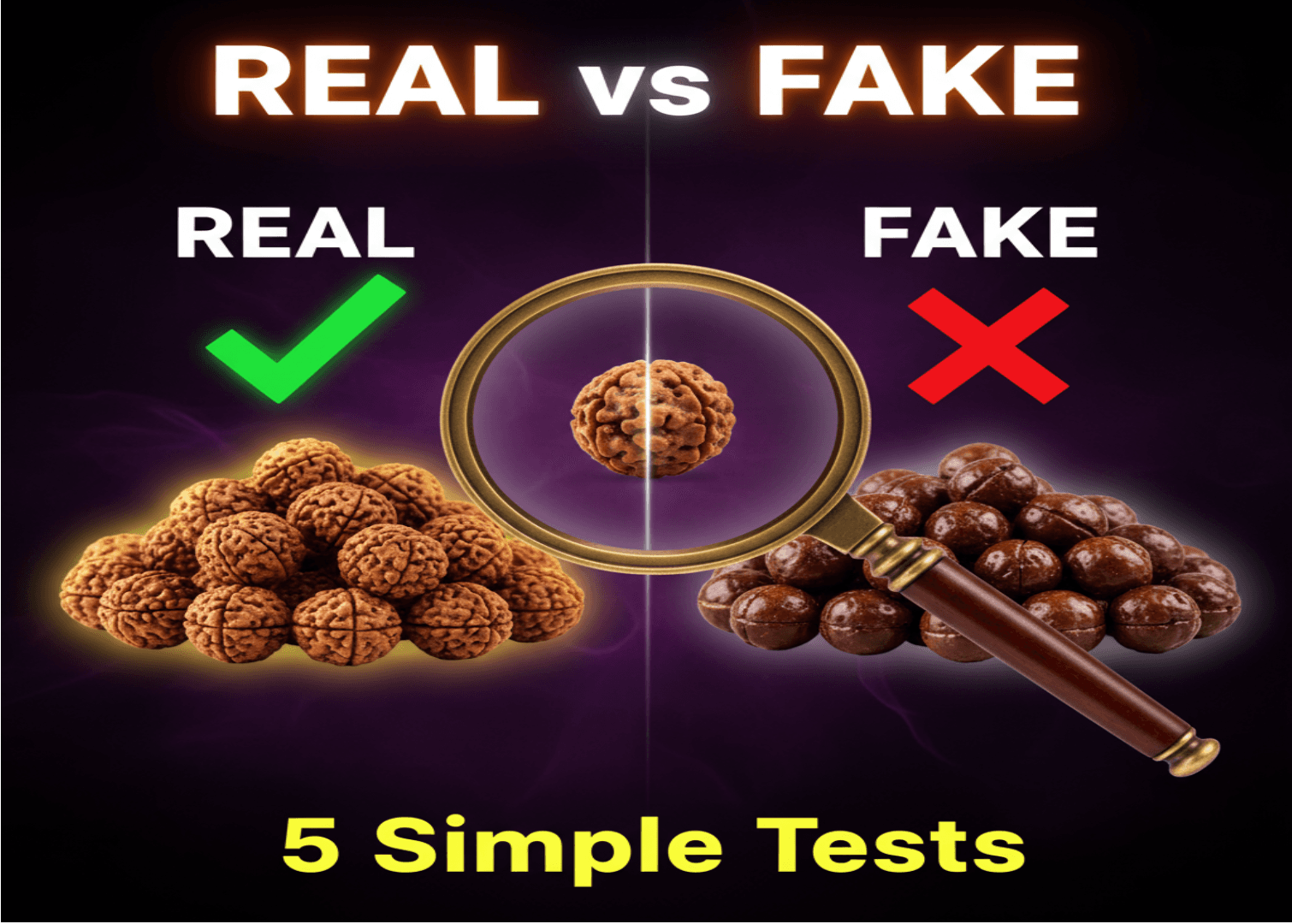
The Fake Rudraksha Problem: The high prices of rare Rudraksha have created an enormous market for counterfeits. Fake beads are made from moulded plastic, seeds of other trees (especially Bhadraksha), or genuine beads with artificially carved extra Mukhis. In some estimates, up to 70% of Rudraksha sold online in India are either fake or heavily misrepresented. Never purchase without a certificate of authenticity from a trusted institution.
6 Certification, Testing & Institutional Sourcing
In response to widespread fraud, several institutions in India and Nepal now offer certified, lab-tested Rudraksha. Reputable organisations conduct X-ray analysis to verify internal seed structure, electromagnetic field testing, physical measurement documentation, and video-recorded authentication. A Rudraksha sold with a GIA-style certificate from a recognised institution carries a premium of 30–200% over an uncertified bead of similar appearance.
This is not a markup for profit — it is the cost of trust. For rare and expensive beads, certification is the only genuine protection a buyer has. For a ₹2 lakh bead, the ₹5,000 certification cost represents less than 3% of the purchase price and is simply non-negotiable for any serious buyer.
7 Gold & Silver Capping
High-quality Rudraksha are often capped in gold or silver — a process that serves both aesthetic and protective purposes. The metal cap preserves the delicate tip of the bead, prevents cracking with age, and allows the bead to be strung on a high-quality chain. Gold-capped Rudraksha from reputable jewellers carry the additional cost of hallmarked gold craftsmanship, which adds ₹5,000 to ₹50,000 depending on the purity and weight of gold used.
8 Astrological Demand & Cultural Timing
Rudraksha prices are also influenced by astrological trends. When Saturn enters a sign that creates widespread Sade Sati (7.5-year Saturn transit), demand for 7 Mukhi Rudraksha surges. When Rahu or Ketu transits create widespread anxiety, 8 and 9 Mukhi beads spike in demand and price. Savvy sellers time their inventory releases around these astrological events.
Additionally, during Mahashivratri and Shravan month, demand for all Rudraksha peaks dramatically — and with limited authentic supply, prices rise accordingly. Festive seasonal premiums of 20–50% are common for certified Nepali Rudraksha during these periods.
9 How to Buy Smart — Getting Real Value
Understanding price drivers allows you to buy wisely. Here are the most important principles for any Rudraksha purchase:
- Always insist on a written authenticity certificate for any bead priced above ₹2,000 — reputable sellers provide this without hesitation.
- For Mukhis 1–4 and 10 and above, X-ray verification is the gold standard of authentication. Ask if the seller can provide this.
- If budget is a concern, a genuine 5 Mukhi Nepali Rudraksha at ₹800–₹2,500 provides excellent energy at a fraction of the cost of rarer beads.
- Avoid unbelievably cheap "Nepali" Rudraksha online — if a supposedly Nepali 14 Mukhi is priced at ₹500, it is almost certainly fake.
- Buy directly from trusted Nepali exporters or reputable Indian spiritual institutions with physical premises and verifiable track records.
- A cracked bead, however high the Mukhi count, is considered inauspicious and should be priced significantly lower — never pay premium for damaged beads.
- Compare multiple sellers for the same Mukhi and size range before purchasing. Price consistency is a sign of genuine market pricing; wild variations signal fraud.
- For investment-grade Rudraksha (₹50,000+), always seek in-person inspection before finalising purchase — photographs are easily manipulated.
The Price is the Story of the Bead
When you hold a costly Rudraksha in your hand, you are holding millions of years of geological evolution, thousands of kilometres of mountain terrain, generations of harvesting tradition, and — according to Vedic belief — the encoded tears of a deity. Every rupee of the price reflects something real.
The most expensive Rudraksha is not the best Rudraksha for everyone. The right bead for you is the one that matches your planetary need, your spiritual intention, and your authentic budget. A genuine 5 Mukhi Nepali Rudraksha worn with devotion outperforms any fake rare bead worn for status.
Choose with wisdom. Buy with caution. Wear with faith.
ॐ NAMAH SHIVAYA ॐ